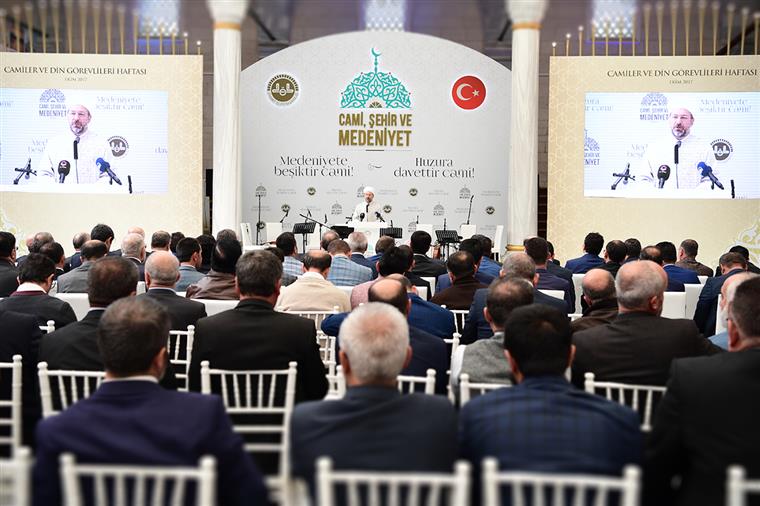
The annual Mosques and Religious Officials Week organized by the Office of the President of Religious Affairs (Diyanet) with a specific team started with an inaugural ceremony held at the courtyard of the Kocatepe Mosque in Ankara.
The annual Mosques and Religious Officials Week organized by the Office of the President of Religious Affairs (Diyanet) with a specific team started with an inaugural ceremony held at the courtyard of the Kocatepe Mosque in Ankara.
The week organized by the Religious Services Directorate General of Diyanet is held with a specific team every year. This year the theme is “Mosque, the City and Civilization.”
President of Diyanet Prof. Dr. Ali Erbaş who spoke at the inaugural program for the event which will be marked with several activities throughout the week said “This year during the ‘Mosques and Religious Officials Week” we are taking up the relationship between Islam, life, the individual and their interrelationship which are three basic concepts of Muslim awareness which are also an important part pf Islam’s notion of the individual, the society and the world. For a whole week we will be pondering on “Mosques, the City and Civilization” studying and learning about all aspects of the issue.”
Offering his condolences over the martyrdom of security personnel who passed away during clashes with terrorists at the Doğubayazıt township of the eastern Ağrı province President of Diyanet Erbaş said “I offer my condolences and wish benediction for the four security personnel who became martyrs at Doğubayazıt in Ağrı. I offer my condolences to their grieved families and to our nation. Our hearts were deeply hurt like this on the 61st year of the Hagira.”
President of Diyanet Erbaş commemorated the martyrs of Karbala who were martyred on Hegira 61 “I commemorate the master of all martyrs Hazrat Hussein and all the martyrs and wish them blessings.”
President of Diyanet Erbaş said Islam has spread and affected the world in a short period and said we need to discuss the concepts of the relationship between mosque, the city and civilization to help explain Islam in a better manner. In this context he made the following points:
“The mosque is at the center of life, the city and civilization in Islam…”
It is important that Islamic thought which spread throughout the world with speed with our Prophet Muhammed Mustafa (pbuh) and affected civilization from Medina should be discussed within the context of the relationship between the mosque, the city and civilization.
The mosque is the center of Islamic life in the city and the civilization in Islam. In world of faith, the mosque is the place that unites the roots of values concerning the formation of servitude, responsibility and good deeds awareness in social relations as well as the establishment of law, education, family relations and all fields concerning human life.
Our Prophet personally worked in the construction of a masjid in Kuba while he was still in the middle of hijrath and he laid the foundation of Masjidi Nebi after his hijrath to Medina. When we take a look at the functions of Masjidi Nebi, we see that all personal social and administrative affairs varying from education to economy were managed from the Masjid. Moreover, most distinguished community of Islam which is the Sahaba Generation were raised in this masjid.
“Mosques are the most concrete mark of an Islamic city…”
Mosques whose domes allow the “tawhid of the Muslim hearts”; whose pulpit and mimbar echo with knowledge and wisdom, whose mihrab makes people faces and eyes turn to Allah and whose minarets became the index finger of cities are the most concrete mark of an Islamic city.
Mosques with both their physical structure and functions and values are the center of Islamic society and mentality.
As physical buildings, mosques are the authentic architectural constructions where arts meet with people with a plain serenity, materials unite with meaning and remind people about the basic principle of Islam.
“Mosques gather us in the line of brotherhood…”
Role of the mosque as a center is not only limited with its physical existence. Mosques also represent values. Domes, mimbar, mihrab and minarets, all these have special meanings. Fundamental principle of Islam which is tawhid and main goal of human kind which is servitude are displayed in mosques in the most concrete way possible. All positions and movements made while performing salaat are the expression of a life sytle. Mimbar and mihrab are the sources of Islamic knowledge and wisdom.
Performing salaat in a mosque by closely standing next to each other in ranks has allowed believers to eradicate status differences and gather people in the line of brotherhood. In this light, the role of mosques in the establishment of individuals and society should be considered as much as its physical existence and functions.
“Building mosques is a duty for Muslims…”
To build mosques, repair and protect them are the duties of Muslims. Muslims are also responsible for protecting, maintaining and reinforcing values that mosques represent such as tawhid, servitude, freedom, brotherhood, equality, unity, solidarity and cooperation.
The Hadith of Prophet of Allah which is “earth was made as a masjid and a clean place for me” gives a message about living on earth according the principles of Islam and recognizing these principles.
Almighty Allah promised persons whose hearts are loyal to masjids, Islamic values, who go to mosques and unite with community that they will shade under the shadow of Ninth Heaven on the Day of Judgment.
“Mosques are not only physical places; they establish a life style and civilization based on tawhid, servitude and brotherhood …”
Throughout the Islamic history, Muslims built masjids before constructing their homes; their intention was not only building physical places. That they established was a life style and civilization based on tawhid, servitude and brotherhood.
“Moral values that the mosque offers to people such as justice, compassion and cooperation are the guarantees of city’s peace and safety. …”
Throughout the Islamic history, cities are designed according to the location of mosques. Mosques defined the center of the city, they were the founding element of city plans and cities were built around mosques. City life develops as a continuation of a mosque. Modesty of mosques is reflected into business life, mercy of mosques is reflected into family life and compassion of mosques is reflected into relationship between people. Moral values that the mosque offers to people such as justice, compassion and cooperation are the guarantees of city’s peace and safety.
“Yathrib transformed into Medina according to the values established by the Masjid…”
In Islam, the city is a place under the rule of law where basic human rights and freedoms are granted and people live in peace and safety. Cities are places where people establish their relations with the environment and society by considering their responsibilities and sensitivities. Cities are the places that prioritize humanitarian values. In the aftermath of hijrath of the Prophet, city of Yathrib became the holy city of Medina according to the values established by the Masjidi Nebi. This city that bloomed around the mosque founded by the Prophet became a model city for Muslims.
“Spirits of Islamic cities are formed according to the mosque-centered values…”
There is the spirit of the city in Islamic philosophy and every city gains meaning with this spirit. What gives the city a meaning are the moral values. If there is no connection between people’s values and the city they live in then this person will feel like a stranger.
Spirits of Islamic cities are formed according to the mosque-centered values. Mosques educated people to establish positive relations with themselves, with Allah, society, environment, personal responsibilities and sensitivities. This relationship turns into a morality experienced in this city and a settled life. Cities founded by virtuous people establish civilizations. Mosques are the heart of the city. Like a heart performing a vital mission in order to clean blood in human body for survival, mosques are the sacred places that establish moral values of the cities. Due to this reason, I call on all of our fellow citizens – children, young and senior – to meet in the peaceful environment of the mosques.
Throughout Islamic history, Muslims founded safe cities around the values represented by mosques; these cities highlight humanitarian values with their peaceful and safe environments. They have built civilizations that became the hope and safe haven of oppressed people.
“Mosques should be designed according to the textures of cities…”
One of the most important issues of today is to urgently review our mosque concept and designs. Mosques should certainly be designed by considering the city texture and population as well as the needs of women, children, disabled and senior people. From now on, mosques should be considered as cultural centers and should include places that will allow mosques to fulfill its cultural role.
On the other hand, we have to reinforce the function of mosques that enriches individuals and society. We have to work in an effort to make values related to mosques such as tawhid, unity, integrity, solidarity, sincerity, brotherhood and modesty more effective in personal and social life.
“Salaat echoed from the minarets of mosques on July 15 clearly revealed the importance of mosques…”
We are the successors of a civilization founded according to the values of mosques. Mosques are a part of our lives not only as a place for prayer but also an important places in our history, literature and traditions. As a matter of fact, mosques were among the most important bases during the War of Independence. Similarly, salaat echoed from the minarets of mosques on July 15 (the night of the coup attempt) revealed the importance of mosques clearly.
We have to fulfill our responsibilities with sacrifice in order to maintain security and peace in our cities. As the members of Islamic civilization, we have to work harder than ever by considering this great responsibility in order to maintain peace, safety and security for human kind who currently experiences one of its hardest periods amidst personal depression and global crisis.
“I would like to congratulate the ‘Mosques and Religious Officials Week’ of all our staff…”
I would like to congratulate the “Mosques and Religious Officials Week” of all our staff. I believe that they will be working with enthusiasm and sacrifice in order to provide religious services to our people like they did since now and wished them success.
I wish from Allah that this year’s theme “Mosque, the City and Civilization” will help us build an important awareness.
At the end of the ceremony, President of Diyanet Erbaş presented the awards of religious officials who were awarded at the contest organized as a part of “Mosques and Religious Officials Week” activities.
In addition to President of Diyanet Erbaş, Chairman of Supreme Religious Affairs Council Dr. Ekrem Keleş, Vice President of Diyanet Prof. Dr. Yavuz Ünal, Vice President of Diyanet Dr. Yüksel Salman, other executives of Diyanet and religious officials were present at the ceremony.
Annual “Mosques and Religious Officials Week” will be celebrated with various different activities all over the country.
All kinds of information about the week that started on October 1 and will last on October 7 can be seen at camilerhaftasi@diyanet.gov.tr